Things to do
Speicherstadt: go late in the afternoon
The brick warehouse quarter is the most atmospheric walk in Hamburg and it is free. What is there, the hour to go, and why most visitors arrive at the wrong time.
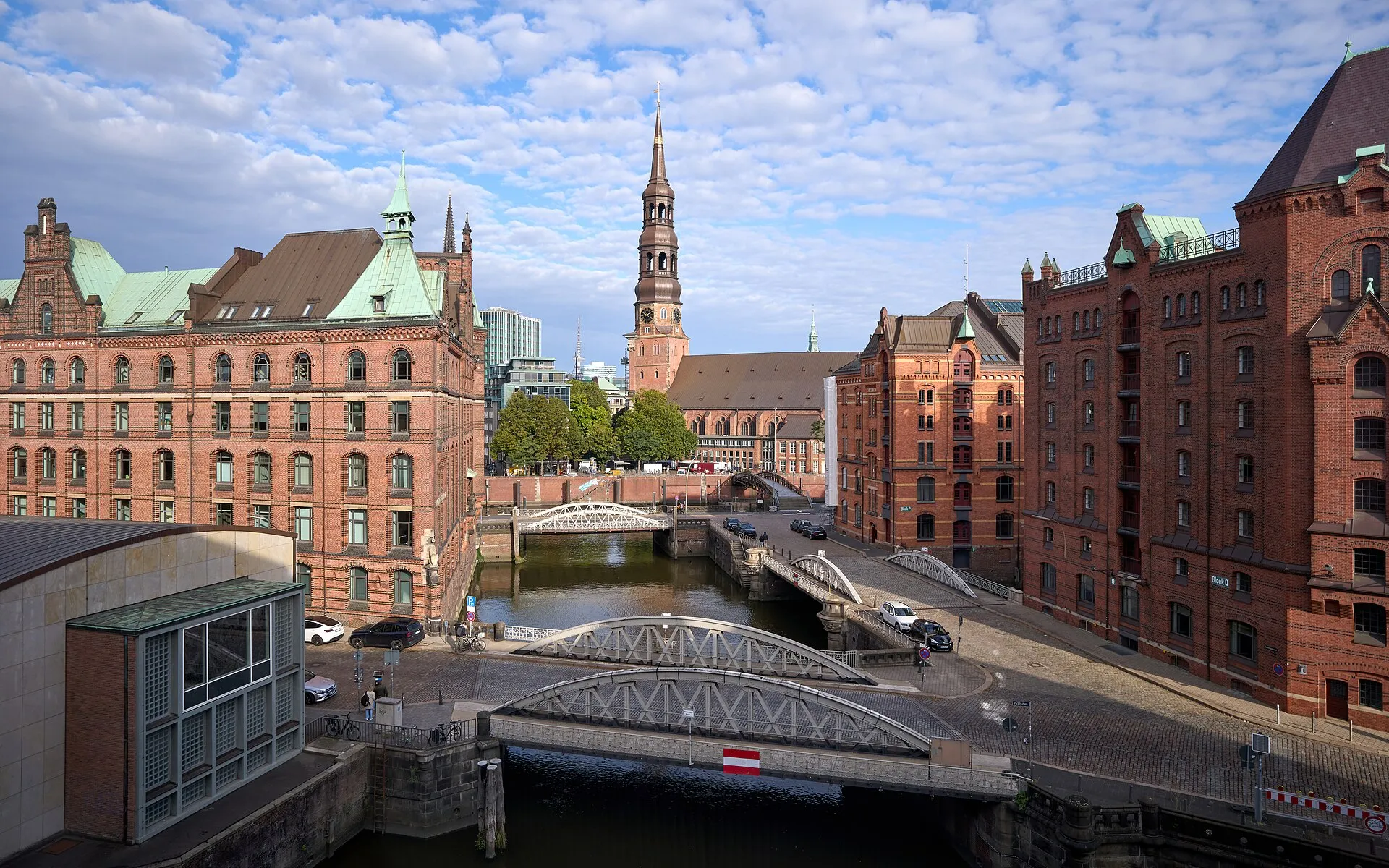
A district of red brick warehouses on piled foundations, cut through by canals and crossed by iron bridges, built in the late nineteenth century for storing goods that arrived by water. It sits between the old town and the harbour, and it is the most photographed part of the city for good reason.
The quarter is also free, walkable in an hour, and visited by most people at entirely the wrong time of day.
What is actually there
The quarter itself is the attraction, rather than anything inside it. Long ranks of warehouse frontage in dark brick, gabled and detailed in a way that industrial buildings usually are not, standing directly out of the water with loading hatches and hoists still in place.
Between them run the canals, and over the canals run the bridges, which is where almost every photograph of this city is taken from. The quarter is compact: you can cross it in fifteen minutes and spend two hours doing so.
Inside the buildings there are museums and attractions, including the model world that draws more visitors than anything else in the district. Some of the warehouses still hold the trades they were built for, and others hold offices, which keeps the quarter from becoming purely a display.
The neighbouring quarter to the east is newer, sharper and worth ten minutes for the contrast.
The hour to go
This is the whole of the practical advice, and it is worth planning around.
Late afternoon, in the last hour of daylight. Low sun runs along the canals rather than down onto them, the brick shifts from brown toward red, and the water holds the reflection of the frontage. The difference between this hour and noon is not subtle.
Why that hour works so well here is a question of latitude, covered in northern light.
After dark is the other version. The bridges and facades are lit, the canals go black, and the result is the image most people have seen. In the cold months this arrives at a reasonable hour; in high summer it means waiting until very late.
Midday is flat light and the most people. If your schedule only allows that, go anyway — but if you have any choice, move it.
How to walk it
No route is needed and none is recommended. The district is small enough that getting slightly lost is the correct approach, and the good views are on the bridges rather than at any particular address.
Two habits help. Cross every canal you come to rather than walking along one side, because the frontage reads differently from each bank. And look up: the detail on these buildings is in the gables and the hoists, well above eye level.
Wear something with grip if it has rained. The quaysides are stone, the bridges are metal, and both are slick in wet weather. This quarter is not a place to hurry in any case.
Seeing it from the water
Small boats enter the canals themselves, which is a different experience from walking the banks: you pass under the bridges, between the buildings, at the level the goods arrived at.
That is worth doing, and it is one of the few cases where a commercial trip gives you something the scheduled ferry cannot. The harbour page covers the distinction between the two kinds of boat trip and when each makes sense.
Combining it with the rest of a day
The district pairs naturally with everything around it, which is unusual in a city this stretched.
An afternoon that works: the model world or another indoor attraction first, the warehouse quarter on foot as the light drops, then dinner in the old town or a short walk west. The two-day plan builds a version of exactly this.
Alternatively, arrive from HafenCity along the water, which is the best approach on foot and takes the district in from its most photogenic side.
Where to stay nearby
The Altstadt borders the quarter to the north, and its southern edge is the single best position in the city for waking up near the brick. That is the main argument for staying in an otherwise workmanlike district.
HafenCity is on the other side and equally close on foot, with more water and less street life.
Both district pages set out what each one charges you in return, which is the part a location advantage does not settle on its own.
What we are not telling you
No opening hours for the museums inside the quarter, no ticket prices, no boat operator names and no claim about how many piles the district stands on.
The first three change and belong to the venues. The last is the kind of figure that gets repeated between guides until nobody can say where it came from, which is precisely the sort of fact this site does not publish without a source. See how we rank for the standard.
The short version
Go in the last hour of daylight, cross every bridge you find, and look up. It costs nothing, it takes an hour, and it is the part of the city visitors remember longest. Then come back after dark if you have the evening, because it is a different place with the lights on. Doing it twice in one day is far easier from a room nearby, which is what staying near the Speicherstadt is about.
No times, no ticket prices
Opening hours, ticket prices and tour durations belong to the venue and the operator, and they change. This page describes what the place is and who it suits, then leaves the numbers where they are kept current. Check the official site on your dates, and see how we rank for the reasoning.
Last reviewed . Editorial analysis and reference information. We have not visited on your behalf, and nothing here is a review.
Common questions
- Is the Speicherstadt free to visit?
- The district itself costs nothing: it is a working quarter of streets, canals and bridges that you walk through. Individual museums and attractions inside it charge admission, and the boat trips through its waterways are commercial services.
- What is the best time of day to see the Speicherstadt?
- The last hour of daylight, when low sun reaches along the canals and the brick turns from brown to red. After dark the bridges and facades are lit, which is the version most photographs show. Midday is the flattest and busiest.
- How long do you need in the Speicherstadt?
- An hour of unhurried walking covers the main canals and bridges. Two hours lets you add a museum or cross into the neighbouring quarter properly. It is compact enough that a route is unnecessary and wandering works better.
- Is the Speicherstadt worth visiting in winter?
- Arguably it is at its best. Low winter sun reaches further along the canals than summer light does, the crowds thin out, and early darkness means the lit version arrives at a civilised hour rather than close to midnight.